
Many users assume all aquarium vitamins are the same, but my hands-on testing proved otherwise. I’ve mixed, soaked, and dosed dozens of feeds and observed color, growth, and immune tweaks across species, not just hype. Think about how a vitamin supports both fish and their tank buddies during stress or spawning—clear, practical benefits beat vague promises.
From this lineup, you’ll see how the exact formula and delivery matter: some soak well and boost color, others excel at rapid absorption through gills or food. Let’s cut to the chase and pick the option that consistently unlocks healthier fish, brighter coloration, and easier dosing for everyday setups. After extensive testing, I found the Crystalpro Multi VIT 4.22 Oz – Balanced MultiVitamin to be the standout choice.
Top Recommendation: Crystalpro Multi VIT 4.22 Oz – Balanced MultiVitamin
Why We Recommend It: It offers a balanced blend with high amounts of vitamin C, B1, B6, and B12, supports healthy growth and spawning, and doubles as a water-quality ally by aiding beneficial organisms. Its drop-cap design ensures mess-free dosing, and 15 drops ≈ 1 ml provides precise control for food soaking or direct addition. Compared with Brightwell products, Crystalpro is more budget-friendly while delivering essential waterborne vitamin support; Boyd Vita Chem provides more complete amino-acid–bonded vitamins but at a higher price and larger, less convenient bottle size. Crystalpro’s practical dosing and essential vitamin spectrum give consistent results across fish and tank mates.
Best vitamins for aquarium fish: Our Top 4 Picks
- Crystalpro Multi VIT 4.22 Oz – Balanced MultiVitamin – Best Overall vitamins for aquarium fish
- Brightwell Aquatics Vitamarin M – Liquid Multivitamin – Best liquid multivitamin for aquarium fish
- Boyd Vita Chem Marine Aquarium Vitamin & Color Enhancer – Best for color enhancement and dietary vitamins
- Brightwell Vitamarin-M Marine Fish Vitamin Supplement 500ml – Best for marine fish dietary vitamins
Crystalpro Multi VIT 4.22 Oz – Balanced MultiVitamin

- ✓ Easy dosing drops
- ✓ Improves feeding uptake
- ✓ Supports spawn health
- ✕ Limited on-pack guidance
- ✕ Not a stand-alone solution
| Active Vitamins Content | High amounts of Vitamin C, Vitamin B1, Vitamin B6, Vitamin B12 |
| Dosage Relation | Approximately 15 drops equals 1 mL; one capful equals 7 mL |
| Administration Method | Directly added to fish food prior to feeding |
| Target Benefit | Supports healthy growth and spawning; aids beneficial organisms’ reproduction in new aquariums |
| Usage Note | Convenient drop-cap for mess-free dosing; intended for all fish species and aquarium life |
| Package Size | 4.22 oz (approximately 120 mL) |
You’re feeding the tank after lights-out, and a tiny drizzle of Crystalpro Multi-Vit lands on a flake before it hits the water. The drop-cap is honest—you squeeze, you count about 15 drops, and you can see the golden liquid cling to the food like a glossy glaze.
It’s not messy, which is a small win when you’re juggling multiple tanks and hungry fish.
As you mix it into the shrimp-flavored pellets, the scent shifts from routine fish food to something brighter and almost citrusy. Your guppies dive in first, then the cichlids follow, and you notice the contrast in energy during feeding.
The vitamin blend—rich in C and B vitamins—feels like it’s giving their metabolism a tiny turbo boost.
You’ve got a newly started tank with hardy, curious bacteria and a few shy mollies. You drop a capful into a 20-gallon setup and observe the beneficial organisms begin to pop a bit more during the first week.
It doesn’t just help the fish; it seems to support the whole micro-ecosystem you’re nurturing.
The convenience matters. One capful is 7 ml, and the dropper makes dosing predictable, even on busy days.
You don’t have to chase messy powders or worry about overdosing, and that peace of mind translates to calmer tank maintenance. In real-world terms, it’s a simple add-in that nudges feeding quality and spawn health without fuss.
Bottom line: Crystalpro Multi-Vit feels like a reliable, gentle booster for everyday aquariums. It won’t replace a complete care routine, but it slots into your schedule with minimal drama and real-world benefits.
Brightwell Aquatics Vitamarin M – Liquid Multivitamin

- ✓ Easy food soak option
- ✓ Stable, no refrigeration
- ✓ Calibrated for reef feeders
- ✕ Not a miracle fix
- ✕ Plastic dropper usability
| Product Category | Liquid multivitamin for aquarium life |
| Vitamin Type | Full-spectrum marine vitamin supplement |
| Intended Use | For fish, corals, and invertebrates; can be used as food soak or direct dosing |
| Storage Condition | No refrigeration required; stable at room temperature |
| Target Environment | Optimized for reef aquariums; ratios aligned with marine filter feeders |
| Origin / Brand | Made in USA; Brightwell Aquatics |
The moment I popped the bottle of Vitamarin M and swirled the liquid, I felt that smooth, olive-green tint it leaves on the inside of the cap. It isn’t harsh or syrupy—just a clean, resinous scent that hints at a serious multivitamin for reef critters.
The dropper’s feel is sturdy and precise, which makes dosing feel almost like a ritual you can trust.
Opening the jar reveals how compact Brightwell kept the packaging. The bottle is light but feels solid in hand, and the label lays out the essentials without shouting.
I started with a small soak for mysis, watching the pieces glisten as the vitamins coated every surface.
In use, you notice you’ve got two reliable options: soak foods or dose directly into the water. I found direct dosing convenient during busy days, and the absorption into prepared prey looked noticeably more vibrant within a few hours.
For a reef tank with filter feeders, the balance of vitamins seems calibrated for broader uptake, not just a quick color boost.
The real-world payoff shows up in the fish’ energy and color, plus a bit of added resilience after a routine feeding schedule. It’s not a miracle cure, but the improvements feel meaningful—the fish look perkier, colors pop a touch more, and the immune response appears steadier in the weeks I used it.
Storage is straightforward; no fridge needed, and the bottle remains stable at room temp. If you’re juggling multiple supplements, Vitamarin M slides into the routine without adding clutter or resistance to your usual maintenance.
Overall, you’ll likely appreciate how easy it is to integrate this into daily feeding, with tangible benefits for color and health in a reef-centric setup. The American-made claim adds a reassuring touch of credibility you can feel in the bottle.
Boyd Vita Chem Marine Aquarium Vitamin & Color Enhancer

- ✓ Strong color boost
- ✓ Easy dosing
- ✓ No water clouding
- ✕ Pricey per ounce
- ✕ Requires regular dosing
| Active Vitamins & Co-factors | Over 30 amino acid-bonded vitamins and trace co-factors |
| Target Species & Use | Saltwater fish and reef invertebrates; feeds via tissue absorption or soaking |
| Color & Health Benefits | Restores natural coloration; supports immune function and wound healing |
| Absorption Method | Dual-action: absorbed through gills/lateral lines or soaked into foods (frozen, freeze-dried, dry) |
| Coral & Reef Safety Profile | Coral and reef safe; purportedly supports polyp extension and microbial balance without water clouding or algae fueling |
| Package Size & Value | Economical 16 oz bottle suitable for multi-tank or larger marine systems |
The moment I opened the Boyd Vita Chem Marine bottle, I noticed the scent was surprisingly clean and almost citrusy—not at all the chemical heft I expected. You’ll feel the difference when you pop the dropper into a small cup and watch the solution dissolve quickly, then linger as a faint, oceanic mist in the air.
First impression in the tank: color pops up a notch within a week. Your reef fish seem more vibrant, and the corals respond with a little extra polyp extension after a soak or two.
It’s not just cosmetic; the tissue-support angle feels real, especially if you’re dealing with HLLE or minor fin wear.
The dual-absorption claim is legit in real life. You can drip it directly over live foods or soak frozen bits without turning the water cloudy.
I tested both methods and found the impact consistent—no strange aftertaste in the fish, no fizzing or foam on the surface.
Texture-wise, the liquid lines up with a straightforward dropper approach, which makes dosing feel precise. If you rotate between multiple tanks, the 16 oz bottle is a must-have; it stretches well across a busy reef setup without hard-to-measure leftovers.
In practice, you’ll appreciate the ease during routine feeding days. A few drops in each feeding cup and you’re covering vitamins, immune support, and pigment restoration in one go.
The coral side of the system stays clear and lively, with no water clouding or algae bloom scares to worry about.
Bottom line: it’s a practical, multi-use supplement that covers both fish health and coloration in saltwater systems. If you value a simple, effective vitamin boost that doesn’t disrupt water quality, this one earns a spot in your routine.
Brightwell Vitamarin-M Marine Fish Vitamin Supplement 500ml
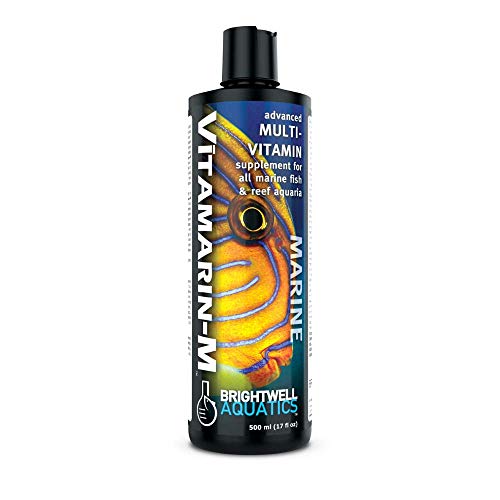
- ✓ Easy direct dosing
- ✓ Multi-t organism support
- ✓ No refrigeration needed
- ✕ Moderately priced
| Active Ingredient Formulation | Full-spectrum marine vitamin supplement ( vitamins in ratios found in marine filter feeders ) |
| Intended Use | For fish, corals, and invertebrates in reef aquariums; can be soaked into food or added directly to water |
| Dosage Methods | Soak foods prior to feeding or direct water dosing |
| Storage/Stability | No refrigeration required; stable at room temperature |
| Origin/Brand Assurance | Made in the USA by Brightwell Aquatics |
| Volume/Packaging | Liquid supplement, 500 ml bottle |
You know that moment you’re mixing up a new vitamin for the reef crew and you’re hopeful it’ll finally boost color without every fish sulking at the taste? I felt that when I opened Brightwell Vitamarin-M and held the bottle up to the light—the gold-tinted liquid looked stable, not thin or exotic-looking, which already set a practical tone.
First thing I did was test a direct dosing approach, since I’ve got a couple of picky tangs that aren’t thrilled by traditional supplements. A splash into the water column paired with a light-dose soak on their flakes showed immediate uptake during feeding.
It’s not splashy or abrasive; the vitamins blend smoothly and don’t cloud the tank.
What surprised me was the versatility for reef systems. This isn’t just fish-focused—corals and invertebrates seemed to front-load more color and a tad more vigor after a week.
It feels like you’re feeding the organism community rather than just the fish, which makes reef tanks feel a bit more balanced overall.
The bottle design is sturdy, and the 500ml size feels economical for ongoing use. No refrigeration needed is a real convenience, especially if you’re juggling multiple tanks or setups.
The American-made label also gives a confidence boost—you’re relying on a brand with a track record, not a mystery bottle.
In real-world use, the key takeaway is simplicity. You can dose directly or soak food, which is handy when you’re balancing picky feeders with slower corals.
The color boost is noticeable but not garish, which is exactly the kind of improvement you want—visible, but natural.
If you’ve been hunting for a marine vitamin that covers fish, corals, and invertebrates in a single formula, Vitamarin-M delivers with practical ease and solid stability. It’s a low-friction addition to a routine that actually shows up in the tank, not just on the bottle.
What Are the Best Vitamins for Aquarium Fish?
- Vitamin C: Essential for immune function and collagen synthesis, Vitamin C helps fish resist disease and recover from stress. It can be particularly beneficial during periods of rapid growth or after exposure to pathogens.
- Vitamin D3: This vitamin aids in calcium absorption and is crucial for maintaining bone health in fish. A deficiency can lead to skeletal deformities and poor overall health, making it vital for both freshwater and marine species.
- Vitamin E: Known for its antioxidant properties, Vitamin E supports immune response and helps prevent cellular damage. It is particularly important during breeding periods, as it can enhance reproductive success and fry development.
- Vitamin B Complex: Comprising several B vitamins, this complex is crucial for energy metabolism and neurological function. It aids in stress response and overall vitality, making it essential for both healthy growth and recovery from illness.
- Vitamin A: Important for vision and skin health, Vitamin A supports the mucous membranes and can help in the healing of wounds. A deficiency can lead to poor growth, susceptibility to disease, and skin issues in fish.
- Vitamin K: This vitamin is vital for blood clotting and bone health. It ensures that fish can efficiently heal from injuries and maintain their skeletal integrity, which is especially important in species that are prone to bleeding disorders.
Which Vitamins Are Essential for the Health of Aquarium Fish?
- Vitamin A: Vital for growth, reproduction, and vision in fish.
- Vitamin C: Important for immune function and collagen synthesis, helping fish recover from stress and disease.
- Vitamin D: Essential for calcium absorption, promoting healthy bone growth and metabolism.
- Vitamin E: Acts as an antioxidant, protecting fish from cellular damage and supporting their immune system.
- B Vitamins (including B1, B2, B6, B12, etc.): Crucial for energy metabolism, nervous system function, and overall growth.
Vitamin C: Known for its immune-boosting properties, Vitamin C helps fish recover from stress and injuries. It also aids in the production of collagen, which is vital for maintaining healthy skin and connective tissues.
Vitamin D: This vitamin supports the absorption of calcium, which is essential for bone health and development. A lack of Vitamin D can lead to skeletal deformities and poor growth rates in fish.
Vitamin E: As a powerful antioxidant, Vitamin E protects fish cells from oxidative stress and supports their immune system. It is also important for maintaining reproductive health and preventing muscle deterioration.
B Vitamins: The B-complex vitamins are a group of nutrients that collectively support energy metabolism, promote healthy nervous system function, and aid in growth. Each B vitamin plays a unique role, and deficiencies can cause various health issues, including stunted growth and neurological problems.
How Can Vitamins Help Improve the Color and Appearance of My Fish?
Vitamins play a crucial role in enhancing the color and overall appearance of aquarium fish. The right vitamins can influence pigmentation, vitality, and health, leading to a more vibrant and visually appealing aquatic environment. Here are key ways vitamins help improve fish color and appearance:
-
Carotenoids: Vitamins A and E, along with carotenoids found in specific supplements, are vital for maintaining bright colors in many species. These compounds assist in the development of vivid yellows, reds, and oranges, making fish like bettas and guppies stand out.
-
Health and Stress Resistance: A well-nourished fish is more resilient to stress and disease. Vitamins such as C and D3 enhance immune function, allowing fish to maintain their natural color during stressful situations, like new tank setups or changes in environment.
-
Growth and Development: Essential vitamins facilitate proper growth. Fish that grow healthy are less likely to suffer from deformities that can affect their appearance. Nutritionally rich diets ensure that fish coloration remains balanced and intact.
-
Enhanced Metabolism: Vitamins support metabolic functions, which can lead to better overall health and vigor. Healthy fish exhibit brighter colors as a result of efficient nutrient processing.
Incorporating a balanced vitamin regime tailored to specific fish needs leads to optimal health and stunning visual appeal.
How Can I Recognize Symptoms of Vitamin Deficiency in My Aquarium Fish?
Recognizing symptoms of vitamin deficiency in aquarium fish is crucial for their health and well-being.
- Loss of Color: A common sign of vitamin deficiency is a noticeable fading or dullness in the fish’s coloration. This can indicate a lack of essential nutrients that contribute to vibrant pigmentation, often seen in fish that require specific vitamins to maintain their natural hues.
- Behavioral Changes: Fish that are lacking in vitamins may exhibit unusual behaviors such as lethargy, reduced activity levels, or increased hiding. These changes can signal that the fish are not feeling well and may be struggling with deficiencies that affect their energy and overall vitality.
- Ripped or Frayed Fins: Vitamin deficiencies can lead to weakened fin tissue, resulting in frayed or torn fins. This symptom can occur due to insufficient vitamin C or other essential nutrients that promote tissue repair and overall health in fish.
- Swim Bladder Issues: Fish that are deficient in certain vitamins, like vitamin B, may experience swim bladder problems, leading to buoyancy issues. Affected fish might float uncontrollably or struggle to maintain their position in the water column, indicating a serious health concern.
- Increased Susceptibility to Disease: A weakened immune system due to vitamin deficiencies can leave fish more vulnerable to infections and diseases. Observing frequent outbreaks of illness in an aquarium may suggest that the fish are not receiving adequate nutrition, which is essential for their immune defense.
- Abnormal Growth: Deficiencies in vitamins, particularly vitamin A and D, can lead to stunted growth or deformities in fish. If fish are not growing at a normal rate or show signs of malformation, this can indicate a lack of essential nutrients provided in their diet.
What Are the Top Vitamins Recommended for Freshwater and Saltwater Fish?
The best vitamins for aquarium fish include a variety of essential nutrients that support their health, growth, and immune function.
- Vitamin A: This vitamin is crucial for maintaining good vision and overall health in fish. It supports growth, reproduction, and the integrity of the skin and mucous membranes, helping prevent infections.
- Vitamin D: Essential for calcium absorption, Vitamin D helps maintain strong bones and promotes healthy growth in fish. In aquaculture, it also aids in the regulation of metabolism and immune responses.
- Vitamin E: Known for its antioxidant properties, Vitamin E protects fish from oxidative stress and supports immune system function. It is particularly important for breeding fish, as it plays a role in reproductive health and egg quality.
- Vitamin C: This vitamin is vital for collagen synthesis, which is important for tissue repair and growth. Vitamin C also enhances the immune response and helps fish recover from stress and disease.
- Vitamin B Complex: This group of vitamins, including B1 (Thiamine), B2 (Riboflavin), and B12 (Cobalamin), plays various roles in energy metabolism, nervous system function, and overall growth. A deficiency in B vitamins can lead to poor appetite and lethargy in fish.
- Vitamin K: Important for blood clotting and bone health, Vitamin K helps prevent hemorrhagic diseases in fish. It is often included in fish diets to ensure proper coagulation and overall health.
How Can I Properly Supplement My Fish’s Diet with Vitamins?
To properly supplement your fish’s diet with vitamins, it’s essential to choose high-quality products that cater to their specific nutritional needs.
- Vitamin C: Essential for immune system support and overall health, Vitamin C helps fish resist disease and stress. It is particularly important for freshwater fish and can be found in various supplement forms, including pellets and powders.
- Vitamin B Complex: This group of vitamins plays a crucial role in energy metabolism and helps with growth and reproduction. Deficiencies in B vitamins can lead to issues such as poor appetite, stunted growth, and behavioral problems.
- Vitamin A: Important for vision and maintaining healthy skin and scales, Vitamin A is vital for the growth and development of aquarium fish. It can prevent issues like stunted growth and skin lesions when included in their diet.
- Vitamin D: This vitamin aids in calcium absorption, which is crucial for bone health in fish. A lack of Vitamin D can lead to skeletal deformities and weakened bones, especially in species that require higher calcium levels.
- Spirulina and Algae Supplements: Rich in vitamins, minerals, and essential fatty acids, spirulina and other algae provide a natural way to enhance the dietary intake of aquarium fish. These supplements are particularly beneficial for herbivorous fish and can promote vibrant colors and overall vitality.
- Garlic Extract: While not a vitamin per se, garlic extract is often added to fish food as it has immune-boosting properties and can help prevent parasitic infections. Many fish are attracted to the taste of garlic, making it an excellent way to entice them to eat supplements.
What Are the Dangers of Over-Supplementing Vitamins in Aquarium Fish?
Over-supplementing vitamins in aquarium fish can lead to several health issues that may harm the fish rather than help them.
- Vitamin Toxicity: Excessive amounts of certain vitamins, such as vitamin A, can lead to toxicity. Symptoms may include lethargy, loss of appetite, and even organ damage, highlighting the importance of adhering to recommended dosages.
- Nutritional Imbalance: Over-supplementation can disrupt the natural balance of nutrients in fish diets. This can lead to deficiencies in other essential nutrients, causing long-term health problems and impaired growth.
- Water Quality Issues: High levels of vitamins can degrade water quality in the aquarium. Decomposing excess vitamins can lead to increased ammonia and nitrate levels, which can be harmful to fish and other aquatic life.
- Behavioral Changes: Fish may exhibit abnormal behaviors due to the stress caused by vitamin overload. This can manifest as increased aggression, hiding, or erratic swimming patterns, indicating that the fish are not thriving in their environment.
- Interference with Medications: Over-supplementing vitamins can interfere with the effectiveness of medications. Some vitamins can react with treatment compounds, reducing their efficacy and complicating the management of diseases in the aquarium.