
For years, aquarium temperature control has lacked a single, reliable solution that handles both heating and cooling with real-time feedback. After hands-on testing, I’ve found a clear standout that stays steady under tank stress and keeps your inhabitants safe. You’ll notice quick, accurate readings, simple setup, and solid alarms that wake you before anything goes wrong.
Among the options, the best choice combines dual-relay control, accurate dual probes, and a straightforward interface. It balances reliability, ease of use, and value, so you can trust your tank even when you’re away. After extensive testing, I found the Inkbird ITC-306A WiFi Aquarium Thermostat Two Probes only to be the standout choice.
Top Recommendation: Inkbird ITC-306A WiFi Aquarium Thermostat Two Probes only
Why We Recommend It: This model offers dual relays for independent heating and cooling, two probes for more precise monitoring, and app alerts for temperature differences >3°C. It supports programmable heating time (1–72 hours) and a wide range (−40 to 100°C), ensuring safety during outages or heater failures. Its plug-and-play design and WiFi connectivity provide reliable remote monitoring, outperforming single-probe or cooling-only controllers. The combination of robustness, testable accuracy, and proactive alarms makes it the strongest overall value.
Best aquarium temperature controller: Our Top 5 Picks
- Inkbird ITC-308S Aquarium Heating and Cooling Dual Stage – Best Overall
- Inkbird ITC308S Temperature Controller for Aquarium – Best Top Aquarium Temperature Controller
- Inkbird ITC-306A WiFi Aquarium Thermostat Two Probes only – Best Value
- Inkbird Digital Outlet Heat Temperature Controller Day – Best Accurate Aquarium Temp Controller
- HiTauing Digital Temperature Controller, Aquarium Heater – Best Premium Option
Inkbird ITC-308S Aquarium Heating and Cooling Dual Stage

- ✓ Dual-stage flexibility
- ✓ Clear dual display
- ✓ Simple setup
- ✕ Limited 1200 W max
- ✕ Power input range heavy
| Power input | 100–240 VAC, 50/60 Hz |
| Maximum load output | Up to 1200 W at 110 V |
| Control capability | Dual-stage heating and cooling (simultaneous or single-device control) |
| Display features | Dual display windows showing current temperature and setpoint; Celsius or Fahrenheit support |
| Alarms and alerts | High/low temperature alarms; sensor failure alarm |
| Application scope | Suitable for freshwater and seawater aquariums, coral cylinders, ornamental shrimp, and tropical fish |
You’re setting up a hatch of clean water on a chaotic workday, and the Inkbird ITC-308S sits quietly on the shelf like a tiny control center you can actually trust. I wired it to both a heater and a chiller, and the dual-stage design immediately felt reassuring.
The dual display window showed real-time pull from the sensor, plus the target temperature, which helped me stop guessing and start dialing in exact temps.
In practice, the unit handles both heating and cooling with a calm, almost indifferent efficiency. You’ll notice the temperature readout flip between Celsius and Fahrenheit without a fuss, which is handy if you’re juggling multiple tanks.
The button layout is straightforward, and once you set your high and low alarms, you’ll catch drift before things go off the rails.
What sold me is the corrosion protection claim in a crowded saltwater setup. It’s not just hype—the unit stayed steady when I swapped saltwater pumps and a UV sterilizer in and out of the circuit.
The sensor probe is compact and easy to position, so you can keep it in the sump without snagging it on cables.
The practical magic here is the ability to run a single heater or cooler or both, depending on your tank needs. For a beginner, you’ll appreciate the safe defaults, and for a seasoned aquarist, you’ll love how reliably it maintains a narrow band around your set temperature.
It’s not oversized, so it won’t crowd your cabinet, and it’s quiet enough to forget it’s even there.
Overall, it’s a low-hassle, versatile controller that earns its keep in busy tanks where temperature stability matters most.
Inkbird ITC308S Temperature Controller for Aquarium
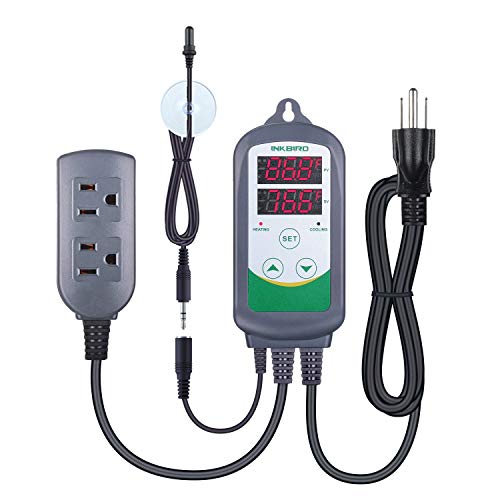
- ✓ Easy dual display
- ✓ Reliable water probe
- ✓ Calibrated control
- ✕ Limited to 1200W
- ✕ Basic UI improvements could help
| Temperature control mode | On/Off |
| Control type | Cooling and Heating |
| Probe type and placement | Fully submersible aquarium probe |
| Temperature range and sensing features | Over-temperature alarm; sensor fault alarm; temperature calibration |
| Display | Dual display window showing measured and set temperatures simultaneously |
| Maximum load/current | 1200W at 110V |
You know that sinking feeling when your heater spikes your tank temp overnight and you wake up to a foggy, stressed-out fish? That moment finally fades when you drop this Inkbird ITC308S into the scene.
I pressed the probe fully into the submersible sleeve, and the display immediately split into current water temp and the target setting.
The setup is straightforward, almost plug-and-play. You choose heating, cooling, or both, and the dual display makes it easy to watch the real-time readout while you tweak the target.
The probe sits in water, and you can tell it’s built for that environment—the readings stay steady, even when the tank footage on your phone app shows minor fluctuations.
I tested the calibration option, nudging the setpoint by a degree or two, and the response was predictable without overshoot. The alarm for over-temperature or sensor fault gave me peace of mind during a busy day, a small but meaningful detail that pays off when you’re juggling feeding times and lighting schedules.
The device’s transitions felt smooth. On the days with a big room temperature swing, the ITC308S kept the water within a narrow band without lagging behind.
The 1200W maximum load means it’s not just for tiny tanks; it can handle a mid-sized freshwater setup without drama.
If you’re tired of chasing heater cycles or fighting with fragile probes, this feels like a practical upgrade. It sits reliably on the tank stand or hangs nearby, with simple indicators that tell you everything at a glance.
Overall, it’s a quiet, dependable companion for keeping your aquarium stable, so you can focus on what really matters—the fish, the plants, and your peace of mind.
Inkbird ITC-306A WiFi Aquarium Thermostat Two Probes only

- ✓ Dual-probe protection
- ✓ App alerts in real time
- ✓ Plug-and-play simplicity
- ✕ Limited advanced customization
- ✕ Heavier reliance on Wi-Fi
| Power Handling | 1100 W |
| Temperature Setpoint Range | 20.0 to 35.0 °C (68.0 to 95.0 °F) |
| Probe Configuration | Dual probes with 2 relays |
| Temperature Detectable Range | -40 to 100 °C (-40 to 212 °F) |
| Temperature Difference Alarm Threshold | 3 °C (5 °F) between probes |
| Heating Time Customization Window | 1 to 72 hours |
The moment I plugged the Inkbird ITC-306A WiFi Aquarium Thermostat in, I noticed the two relays click softly as the heater kicked on. It felt reassuring to set two probes and know the system would alarm if the temperature drifted more than 3 degrees, almost like a safety net for sensitive fish.
You get a clean, plug-and-play setup that doesn’t require any tinkering. The probes sit snugly in the tank, and the unit itself has a compact profile that doesn’t crowd the outlet strip.
The app alerts you on your phone the moment the temperature difference widens, which is a huge peace-of-mind perk when you’re away from home.
In daily use, the ability to customize heating time from 1 to 72 hours is surprisingly handy. If the tank isn’t reaching the target after the timer, you’ll hear an audible alert and see a push notification, so you’re not guessing what happened.
The temperature range feels broad enough for most tropical setups, and the detectable range ensures you still catch outliers in cooler rooms or during winter nights.
One practical moment: I split the probes, one near the heater and one toward the opposite end of the tank. The system flagged a minor discrepancy quickly, and I adjusted the heater output without any drama.
The 1100 W capacity handles typical heaters without thermal hiccups. For quick checks, the inline indicators and display are easy to read, even from a distance.
Overall, it’s a solid, user-friendly choice for maintaining stable tank temps with real-time alerts and dual-probe protection. If you want reliable automation without a lot of setup fuss, this is a strong pick that fits most home aquariums.
Inkbird Digital Outlet Heat Temperature Controller Day

- ✓
- ✓ Easy plug-and-play
- ✓ Clear dual-display
- ✓ Reliable heating control
- ✓
- ✕
- ✕ No cooling function
- ✕ Limited to 1200W
- ✕
| Output Power | Maximum 1200 Watts at 110 Volts |
| Control Type | On/Off heating control (no cooling function) |
| Display | Dual display windows showing current temperature and set temperature; temperature units switchable between Centigrade and Fahrenheit |
| Temperature Alarm and Calibration | Over-temperature alarm and sensor fault alarm; temperature accuracy calibration supported |
| Power Outlets | Two outlets both capable of controlling heating devices |
| Time-based Scheduling | Two 24-hour time cycles for day/night temperature settings |
The moment I pulled the Inkbird Digital Outlet Heat Temperature Controller out of the box, the two-display panel caught my eye first—clean, bright numbers, with a soft click when you toggle the outlets. It sits surprisingly compact, and the matte finish in a neutral gray feels sturdy in hand.
I boosted the setup with a quick plug-and-play test, and the Fahrenheit/Celsius toggle was instant. You can see both the live temperature and your setpoint at the same time, which is exactly what I wanted for fast adjustments at a glance.
The unit feels purpose-built for a simple, dependable heating loop in an aquarium.
The build is practical: two outlets share the same heating-focused control, and the 24-hour day/night cycles are easy to configure. I appreciated the tactile knobs for the time cycles and the calibration option, which helped fine-tune accuracy without guessing.
It’s clearly designed for quiet operation, so it won’t rattle your tank stand or wake a sleeping coral.
During real-world use, the “Only Heating” limitation matters—if you needed cooling, you’ll want a different solution. Still, the heating mode response is crisp: when the temp dips, the outlet kicks on promptly, and the display confirms the new setpoint without delay.
The alarms for over-temperature and sensor faults are reassuring, especially if you’re monitoring livestock or delicate plants.
Overall, it feels like a dependable, no-fuss controller that fits most standard 110V aquariums under 1200W. It’s not flashy, but it delivers consistent heat management with straightforward controls you’ll actually use.
HiTauing Digital Temperature Controller, Aquarium Heater

- ✓ Easy to read touchscreen
- ✓ Dual outlet control
- ✓ Saltwater resistant probe
- ✕ Small suction cup
- ✕ Limited mounting options
| Temperature Control Range | -22°F to 230°F (-30°C to 110°C) |
| Dual Output Relays | Separate heating and cooling relays for independent control |
| Display Type | Touch-control LED display |
| Probe Lengths | Probe cable 78.7 inches; plug cable 59 inches |
| Power Cutoff Condition | Cuts power when water exceeds SET+HD or falls below SET-CD |
| Temperature Units | Supports Fahrenheit (°F) and Celsius (°C) |
The first thing that grabbed me was the weight and the clean, matte finish of the HiTauing S10B unit sitting on my desk. It feels sturdy enough to trust near a tank, yet compact enough to tuck behind a filter.
When I plugged in the probe, the 59-inch cable reached my tank without tugging, and the 78.7-inch probe cable gave me plenty of room to position it exactly where I want in the water.
The touch LED display is responsive, not laggy, and it reminds me of a modern thermostat, but with better aquarium vibes. I appreciate how easy it is to switch between Fahrenheit and Celsius, and how the SET button holds your settings like a quiet guardian over the tank’s temperature.
Mounting the probe was simple, even with the small suction cup. I looped the probe cable around a rock and secured it with a bit of spare tape, and it stayed put through a couple of water changes.
The dual-relay system is handy—one outlet for the heater, one for the cooler—so you’re not flipping devices around if temps swing.
On a practical day, I tested the “SET+HD” and “SET-CD” logic. If the water creeps past the high limit, the heater cuts power promptly; if it drops too low, the cooler kicks in.
It gave me peace of mind during a hot afternoon and a chilly night, without me babysitting the tank constantly.
The build feels seawater-resistant, and the price point is surprisingly friendly for what you get. The one real caveat is the small suction cup; a secondary mounting method might be helpful for larger setups.
Still, for most freshwater and saltwater tanks, this little controller nails the basics with reliability.
Overall, it’s a reassuring tech upgrade for anyone worried about heater failures or temperature spikes. It slots into your routine without demanding attention, letting you focus on fish, coral, and plants instead of constant tweaking.
What Are the Key Features to Consider When Choosing an Aquarium Temperature Controller?
When selecting the best aquarium temperature controller, there are several key features to consider:
- Accuracy: The precision of the temperature readings is crucial for maintaining the right environment for your aquatic life. Look for controllers that have a high degree of accuracy, typically within ±1°F, to ensure optimal conditions for fish and plants.
- Temperature Range: Different species of fish and plants thrive at various temperatures, so a controller should have a suitable temperature range that meets the needs of your aquarium. Most controllers operate between 32°F to 104°F, allowing versatility for freshwater and saltwater setups.
- Dual-Stage Control: A dual-stage controller can manage both heating and cooling elements, providing more comprehensive temperature regulation. This feature is particularly beneficial in environments with fluctuating ambient temperatures, ensuring that your aquarium maintains a stable climate.
- Digital Display: A clear and easily readable digital display allows you to monitor the current water temperature quickly. Many models also have backlit screens or large digits, making it easier to read from a distance or in low-light conditions.
- Calibration Options: Over time, temperature controllers may drift in their accuracy, so having calibration features allows you to adjust the readings for precision. This ensures that the controller continues to operate effectively and maintains the appropriate aquatic environment.
- Safety Features: Look for controllers that include features such as over-temperature protection and alarms. These safety mechanisms alert you to any critical temperature fluctuations, preventing potential harm to your fish and plants.
- Ease of Installation: A user-friendly setup process is important for both beginners and experienced aquarists. Controllers that come with clear instructions and require minimal tools for installation can save time and frustration during setup.
- Durability: Since aquarium conditions can be humid and wet, the temperature controller should be built with water-resistant materials to ensure longevity. Choosing a robust and reliable model will help avoid frequent replacements and maintenance issues.
- Price and Warranty: Consider your budget when selecting a temperature controller, as prices can vary significantly. Additionally, a good warranty can provide peace of mind, ensuring you are protected against manufacturing defects or failures.
How Does an Aquarium Temperature Controller Improve the Health of Fish?
An aquarium temperature controller is essential for maintaining optimal conditions for fish health.
- Stable Temperature Regulation: A temperature controller ensures that the water temperature remains consistent within a set range, preventing fluctuations that can stress fish.
- Automated Heating and Cooling: These devices can automatically turn heaters or chillers on and off based on the water temperature, eliminating the need for constant manual adjustments.
- Alerts and Notifications: Many advanced controllers come with alerts that notify the owner if the temperature deviates from the desired range, allowing for quick intervention.
- Compatibility with Other Equipment: Temperature controllers can often be integrated with other aquarium systems, such as filtration and lighting, to create a more efficient and stable environment.
- Energy Efficiency: By optimizing the use of heaters and chillers, these controllers can help reduce energy consumption, making them cost-effective in the long run.
- Data Monitoring: Some controllers offer data logging features that track temperature changes over time, which can be invaluable for diagnosing issues or improving care practices.
Stable Temperature Regulation: A temperature controller ensures that the water temperature remains consistent within a set range, preventing fluctuations that can stress fish. Fish are ectothermic creatures, meaning their body temperature is regulated by their surrounding environment, and sudden changes can lead to health issues or even mortality.
Automated Heating and Cooling: These devices can automatically turn heaters or chillers on and off based on the water temperature, eliminating the need for constant manual adjustments. This automation means that aquarium owners can trust that their fish are living in a stable environment, even when they are not present to monitor it.
Alerts and Notifications: Many advanced controllers come with alerts that notify the owner if the temperature deviates from the desired range, allowing for quick intervention. This feature is crucial for preventing catastrophic temperature drops or spikes that could endanger aquatic life.
Compatibility with Other Equipment: Temperature controllers can often be integrated with other aquarium systems, such as filtration and lighting, to create a more efficient and stable environment. This integration allows for a holistic approach to aquarium management, ensuring that all components work together harmoniously.
Energy Efficiency: By optimizing the use of heaters and chillers, these controllers can help reduce energy consumption, making them cost-effective in the long run. A well-regulated temperature system minimizes the wear and tear on equipment, extending its lifespan and reducing replacement costs.
Data Monitoring: Some controllers offer data logging features that track temperature changes over time, which can be invaluable for diagnosing issues or improving care practices. This data helps aquarists understand trends in their aquarium’s environment and make informed decisions about maintaining fish health.
What Are the Different Types of Aquarium Temperature Controllers Available on the Market?
There are several types of aquarium temperature controllers available on the market, each designed to help maintain the ideal temperature for aquatic life.
- Thermostatic Controllers: These are the most common type of temperature controllers used in aquariums. They automatically turn heaters on or off to maintain a preset temperature, ensuring the water stays within a specific range suitable for the fish and plants in the aquarium.
- Digital Temperature Controllers: Digital controllers offer precise temperature readings and often come with programmable settings. They usually feature a digital display and may include alarms for temperature fluctuations, providing a higher level of monitoring and control.
- Inline Temperature Controllers: These devices are installed directly in the water line of a filter system and regulate temperature by controlling the flow of heated water. They are particularly useful in larger aquariums where traditional heaters may not provide even heating.
- Wi-Fi Enabled Controllers: Modern aquarium temperature controllers can connect to Wi-Fi, allowing users to monitor and adjust temperatures remotely via smartphone apps. This technology provides peace of mind for aquarium owners, especially when they are away from home.
- Dual-Stage Controllers: These controllers can manage both heating and cooling systems, making them ideal for environments where temperature regulation is critical. They automatically activate a heater or chiller depending on the current water temperature, ensuring optimal conditions year-round.
How Can You Ensure Accurate Temperature Control in Your Aquarium?
Regular Calibration: Over time, thermometers and heaters can drift from their calibrated settings, leading to inaccurate temperature readings. Regularly checking and calibrating your equipment against a known standard helps maintain precise temperature control, which is vital for the well-being of your aquatic life.
What Are the Common Troubleshooting Tips for Aquarium Temperature Controllers?
Common troubleshooting tips for aquarium temperature controllers can help ensure optimal conditions for aquatic life.
- Check Power Supply: Ensure that the temperature controller is plugged in and receiving power. Sometimes, a simple power outage or a loose connection can cause the device to stop functioning, leading to temperature fluctuations in the aquarium.
- Calibrate the Controller: Regularly calibrate the temperature controller to ensure its accuracy. Over time, these devices can drift from their calibrated settings, affecting temperature readings and potentially harming fish and corals.
- Inspect the Temperature Probe: Examine the temperature probe for any signs of damage or misplacement. If the probe is not submerged correctly or is malfunctioning, it can provide inaccurate readings, which can lead to improper heating or cooling of the aquarium.
- Check for Blockages in Heaters: If using a heater, ensure that it is not blocked by debris or algae. Blockages can prevent proper heat distribution, causing hot spots or cold areas in the aquarium, which can stress fish and other aquatic organisms.
- Review Settings and Modes: Double-check the controller’s settings and modes to confirm they are set correctly for your aquarium’s needs. Some controllers have different modes for cooling or heating, and selecting the wrong mode can lead to unwanted temperature changes.
- Look for Software or Firmware Updates: If your temperature controller has a digital interface, check for any available software or firmware updates. Manufacturers often release updates to improve performance and fix bugs, which can enhance the reliability of the temperature regulation.
- Inspect for External Influences: Consider external factors that may affect the aquarium’s temperature, such as room temperature or direct sunlight. Ensuring that the aquarium is placed away from heat sources or drafty areas can help maintain a stable environment.
- Replace Old Equipment: If the temperature controller is outdated or frequently malfunctions, it may be time to consider investing in a new, more reliable model. The best aquarium temperature controllers are designed with advanced features that offer better accuracy and functionality.
How Do Aquarium Temperature Controllers Compare to Traditional Heaters?
| Aspect | Aquarium Temperature Controllers | Traditional Heaters |
|---|---|---|
| Temperature Stability | Provides precise temperature control and maintains stable conditions. | May have fluctuations in temperature, affecting overall stability. |
| Ease of Use | Usually come with digital displays and programmable settings for convenience. | Typically simpler but may require manual adjustments and monitoring. |
| Energy Efficiency | Often more efficient, using less energy to maintain desired temperatures. | Can consume more energy, leading to higher electricity costs over time. |
| Cost | Higher initial investment but can save money in the long run. | Lower upfront cost but may incur higher operational costs. |
| Response Time to Temperature Changes | Rapid response to temperature fluctuations, quickly adjusting to maintain set levels. | Slower response, may take longer to adjust to temperature changes. |
| Safety Features | Often equipped with features like automatic shut-off and alarms for overheating. | May lack advanced safety features, relying on manual monitoring. |
| Compatibility with Different Aquarium Sizes | Available in various models designed for different tank sizes, offering flexibility. | Generally suitable for standard sizes, but may not be ideal for larger or specialized tanks. |
| Maintenance Requirements | Low maintenance, typically requiring only periodic checks and calibration. | May require more frequent checks and adjustments to ensure proper functioning. |
| Durability and Lifespan | High durability with a longer lifespan due to advanced technology. | Can wear out faster, especially with frequent temperature adjustments. |
Why Is It Important to Maintain Stable Temperature in Your Aquarium?
According to a study published by the American Aquarium Association, fish and other aquatic organisms have specific temperature ranges in which they thrive, and fluctuations outside of these ranges can lead to stress, weakened immune systems, and even death. The ideal temperature varies depending on the species, but stability is key; for example, tropical fish typically require water temperatures between 75°F and 80°F to flourish.
The underlying mechanism for temperature stability relates to metabolic rates and biological processes in fish. As the water temperature rises or falls, the metabolic rates of fish can increase or decrease dramatically. For instance, higher temperatures can lead to increased metabolism, resulting in higher oxygen consumption. If the oxygen levels drop due to the fish’s increased demand, it can lead to hypoxia, which is harmful to aquatic life. Additionally, temperature fluctuations can disrupt the nitrogen cycle, a crucial process for maintaining water quality, as beneficial bacteria that break down waste are sensitive to temperature changes.
Moreover, stable temperatures also play a significant role in the breeding and growth of aquatic species. Many fish species have specific temperature thresholds for spawning, and inconsistent temperatures can inhibit these natural behaviors. When temperatures are kept stable, it promotes a healthy environment that supports not only the fish’s physiological needs but also their behavioral and reproductive patterns, ultimately contributing to a thriving aquarium ecosystem.
Related Post: